The Full Story Behind the Work
There is a moment before dawn on the first morning of May where the world holds its breath.
The air is still. The ground is cold beneath bare feet. The light has not yet decided what it will become.
And in that moment, the veil thins.
For centuries, across Scotland, women rose early on Beltane morning to gather the dew. Not rain. Not water drawn from a well. Something quieter. Something that had settled overnight, untouched, unseen. They would wash their faces in it, believing it would bring beauty, vitality, protection for the year ahead.
A simple ritual, on the surface.
But very little in folklore is ever that simple.
The Anointing
In this work, she does not gather the dew herself.
She is anointed.
The birds do it for her.
And that changes everything.
There is a quiet surrender in that act. A relinquishing of control. A trust, or perhaps a vulnerability, to forces that are not entirely understood.
What is given freely is not always benign.
The Yellowhammer
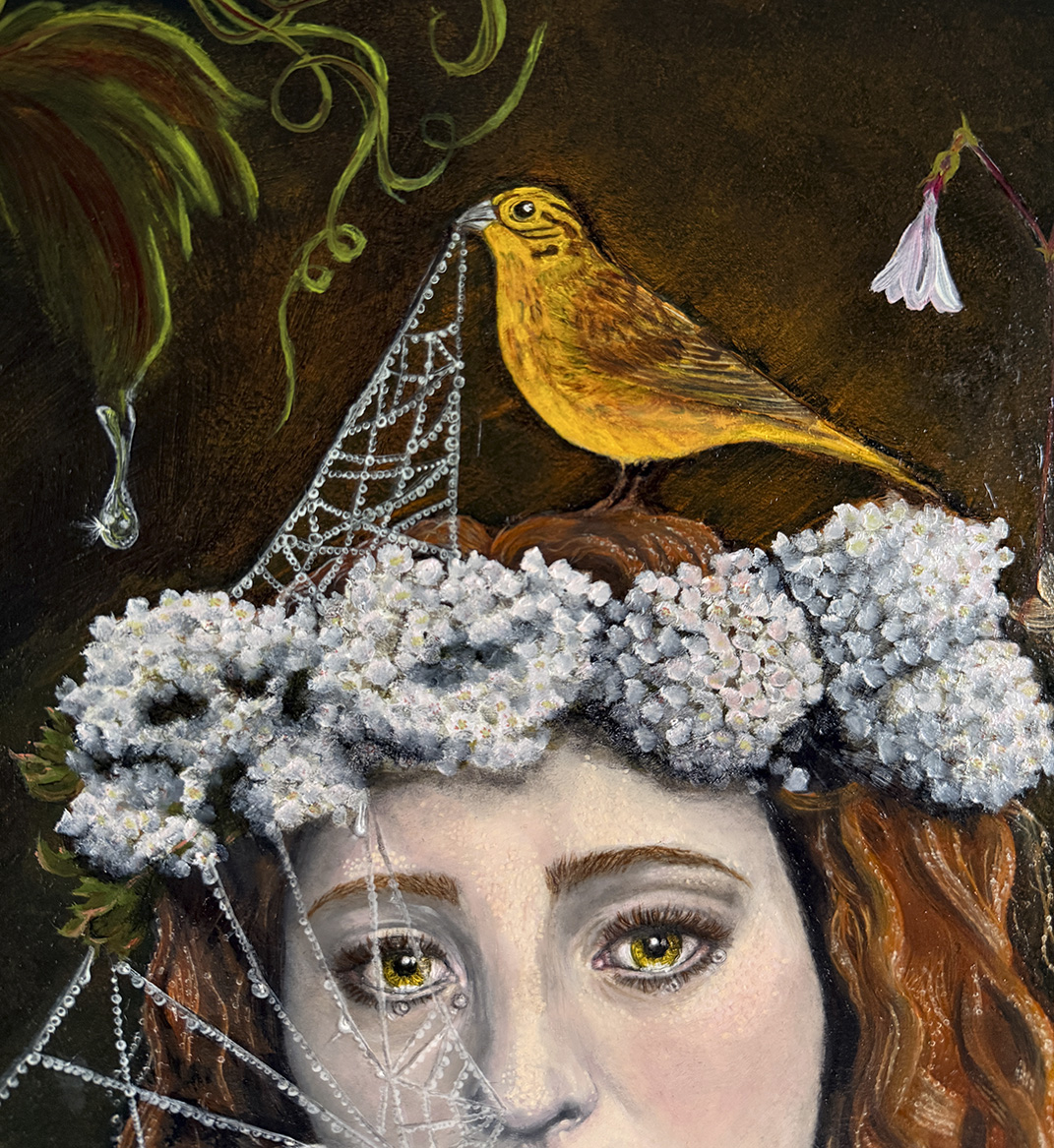
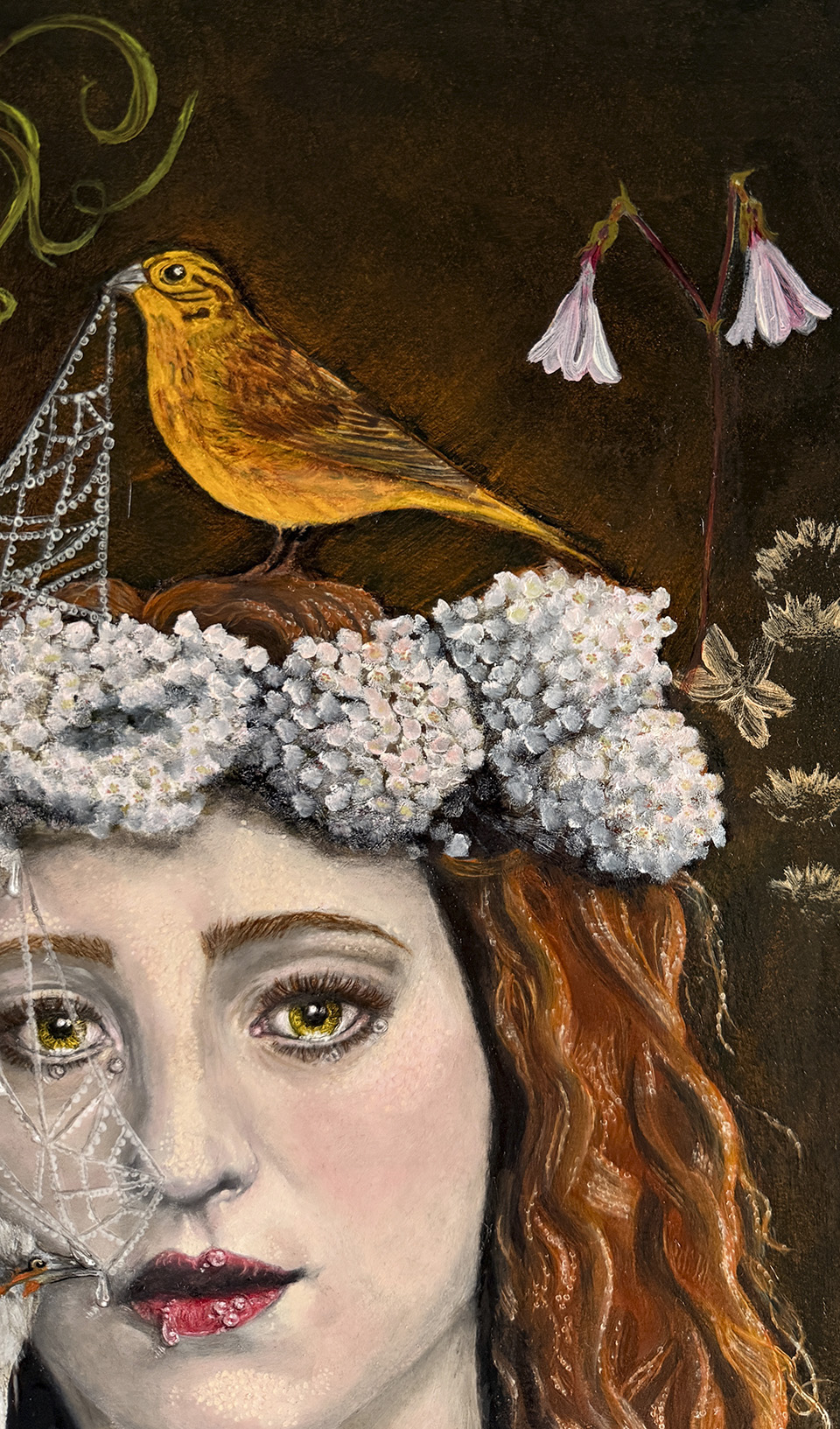
Above her, the yellowhammer.
Bright. Golden. Almost radiant.
And yet, historically, deeply mistrusted.
Known as the “Scotch canary”, its song in the Highlands was interpreted as a warning. A phrase attributed to the De’il himself. It was believed to drink the De’il’s blood on May morning.
It carries contradiction.
Light and darkness in the same breath.
A bird of hedgerows and farmland. Familiar. Common. And yet burdened with something older, heavier, more uneasy.
It stands at the crown of the piece.
Not decorative. Not passive.
Watching.
The Cuckoo
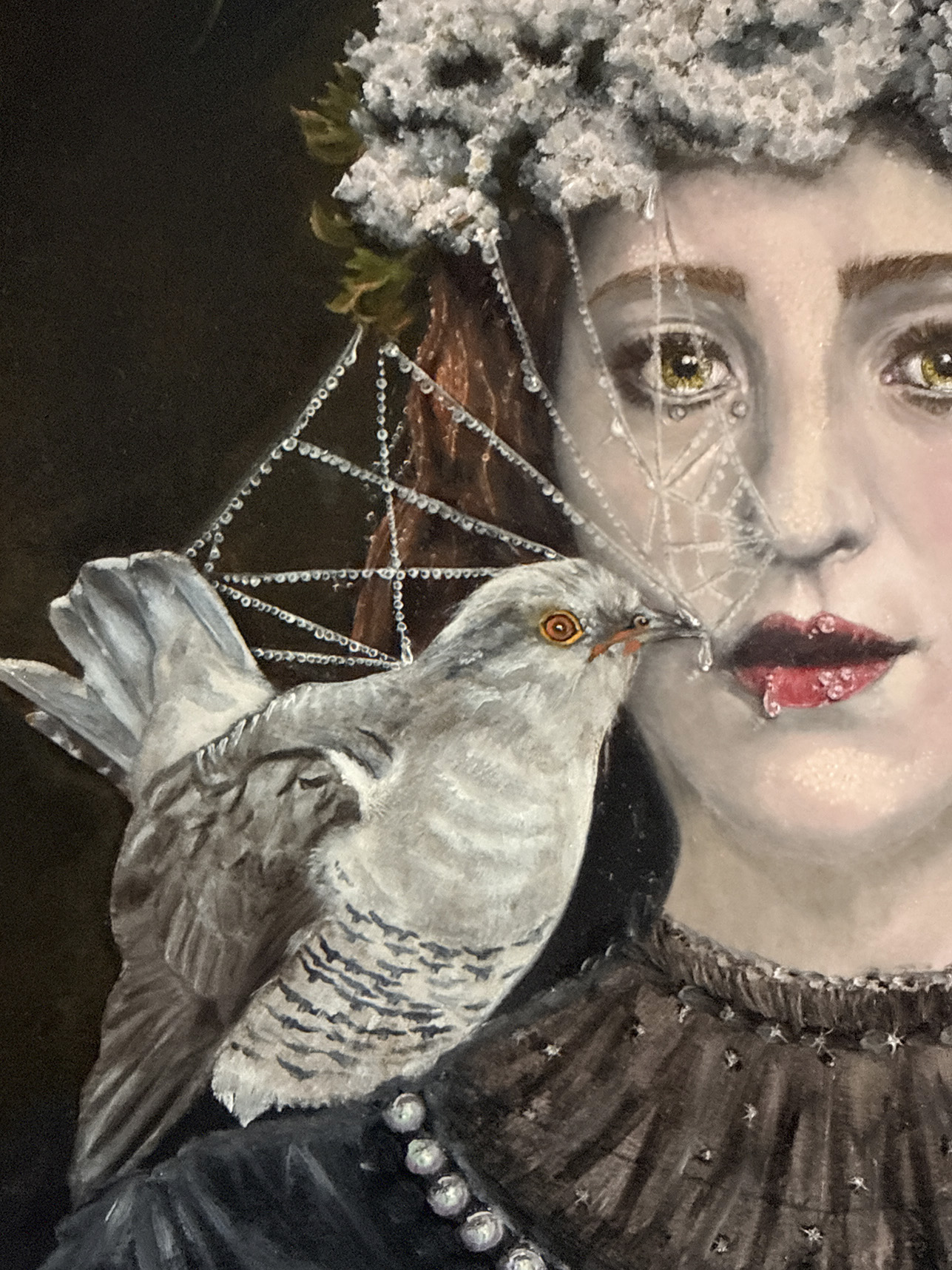
At her lips, the cuckoo.
A bird of spring, of return, of love. But also of deception.
In Scottish folklore, the cuckoo is not entirely of this world. It is a fairy bird. A traveller between realms. Its call was said to predict marriage, fortune, even the length of a life.
But it does not raise its own young.
It places them into the nests of others. A quiet, instinctive act of displacement.
Within folklore, this behaviour became something else entirely. Stories of changelings. Of children taken and replaced. Of something that looks familiar, but is not.
So when it touches her lips, offering dew, there is tenderness. And there is doubt.
The Hawthorn Crown
She wears hawthorn.
Not as ornament. As threshold.
The hawthorn tree is sacred in Scottish folklore. A fairy tree. A place where worlds meet. Where the boundary between what is seen and unseen becomes permeable.
To cut it is to invite misfortune.
To bring it inside is to risk something darker still.
It protects. And it warns.
It marks the moment where winter ends and summer begins. Where something shifts, whether we are ready for it or not.
To wear it is not benign.
The May Dew
The dew itself is central.
It was believed to heal skin, bring beauty, ensure good fortune. A kind of quiet, natural alchemy.
But here, it is reframed.
It gathers in webs. It hangs from vine. It is held, suspended, offered.
Not collected. Not chosen.
Given.
There is a difference.
The Vine and the Drop
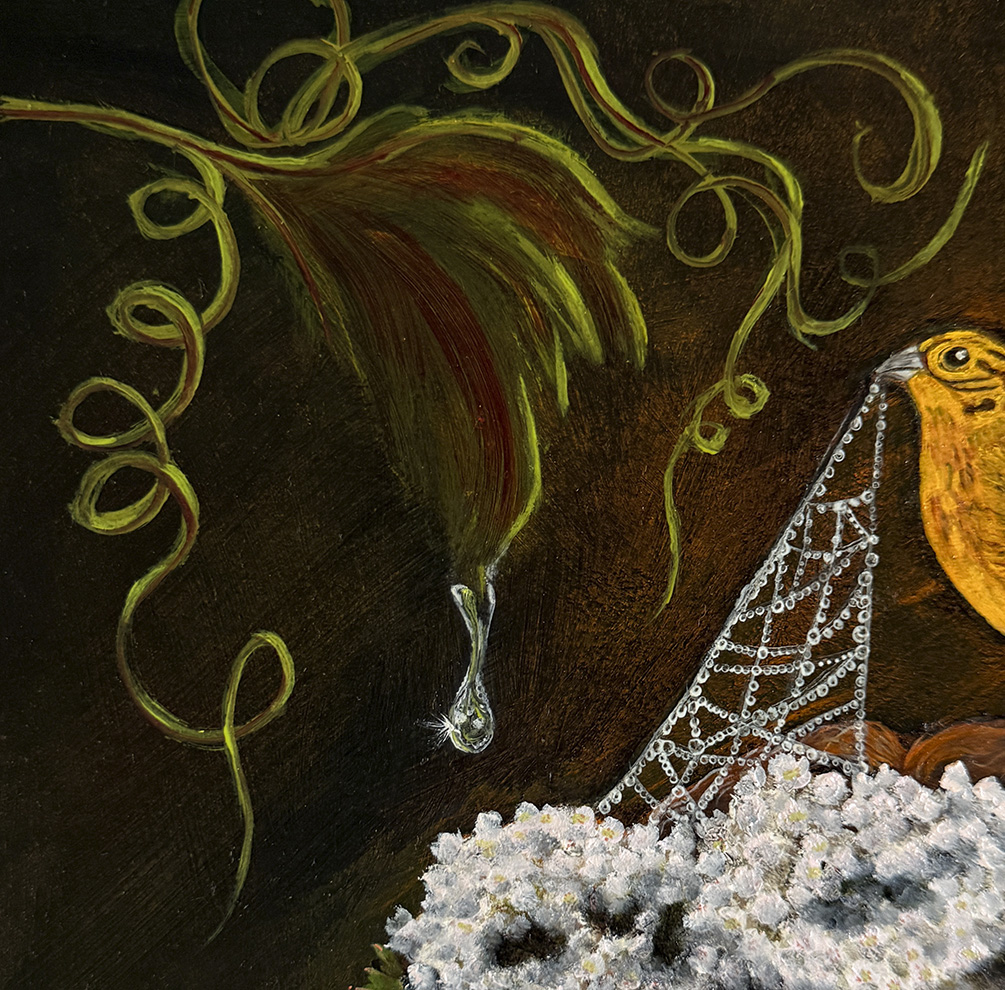
Above her, a twisting vine.
Alive. Reaching. Unruly.
And from it, a single, heavy drop.
It holds tension.
It is about to fall, but has not yet fallen.
It mirrors the moment itself. The pause before something changes. The weight of something that cannot be held forever.
It draws the eye, but quietly.
A detail that reveals itself slowly.
The Web and the Weaving
Across her face, the web.
Delicate. Precise. Intentional.
In Celtic folklore, spiders are not simply creatures. They are weavers. Associated with fate, with storytelling, with the unseen threads that connect and shape lives.
The web becomes both veil and structure.
It obscures, but it also reveals.
It catches the dew. It holds it. It redirects it.
Nothing moves through it without consequence.
The Twinflower
To the side, almost hidden.
The twinflower.
You could miss it entirely.
A small, nodding plant of the Caledonian pinewoods. Rare. fragile. Often found in pairs, its two blooms mirroring one another.
It speaks of connection. Of quiet companionship. Of something enduring in difficult conditions.
But also of loss.
Its presence in Scotland is diminishing. Fragmented. Struggling to survive in isolation.
It is a quiet marker of what is slipping away.
The Black Pearls
Around her neck, black pearls.
Not ornamental. Not purely symbolic of purity or status, as pearls often are.
These are something else.
Scottish freshwater pearls were once prized across Europe. Objects of protection, prosperity, and power.
But the darker pearls, the rare ones, carry a different weight.
They are associated with deeper knowledge. Protection from unseen forces. A connection to something older, more elemental.
They ground the piece.
They hold it.
The Face
She does not resist.
She does not lean in.
She receives.
There is no fear. But there is no certainty either.
Her expression sits in that same tension that runs through the entire work.
Between acceptance and awareness.
Influences
This piece sits in conversation with multiple histories.
The stillness and structure of Renaissance portraiture.
The symbolism and narrative layering of the Pre-Raphaelite Brotherhood.
The softness and psychological presence found in John Singer Sargent’s work.
And more contemporary echoes.
The surreal, mythic storytelling of Annie Stegg.
The atmospheric, symbolic compositions of Christopher Remmers.
Not imitation. But lineage.
Research and Process
This work is built slowly.
Layered through reading, collecting, observing.
Texts such as:
- Ancient Witchcraft of the Scottish Highlands – John Gregorson Campbell
- The Folklore of Birds: The Forgotten Tales – Alison Davies
- Scottish Birds, Folklore and Traditions – Robin Hull
These are not referenced lightly. They are absorbed. Questioned. Reinterpreted.
Folklore is not fixed. It shifts. It evolves. It is retold.
Building the World
Before the painting begins, the world is built elsewhere.
Pinterest boards become working libraries. Not for aesthetics alone, but for structure. Colour palettes. Botanical accuracy. Historical references. Fragments of fabric, light, gesture.
Everything is gathered.
Everything is tested.
The palette is not accidental. The placement of each element is considered. Moved. Removed. Reintroduced.
Sound and Atmosphere
Music plays a constant role in the studio.
Not as background noise, but as atmosphere.
A curated playlist sits alongside the work. Shaping pace. Tone. Emotional weight.
For Collectors
This is the part that is rarely seen.
The hours of research. The layering of meaning. The decisions that sit beneath each detail.
Nothing here is decorative.
Everything carries weight.
The May Anointing is not a simple depiction of beauty or ritual.
It is about what we inherit. What we trust. What we accept without question.
And what sits just beneath the surface of it all.